
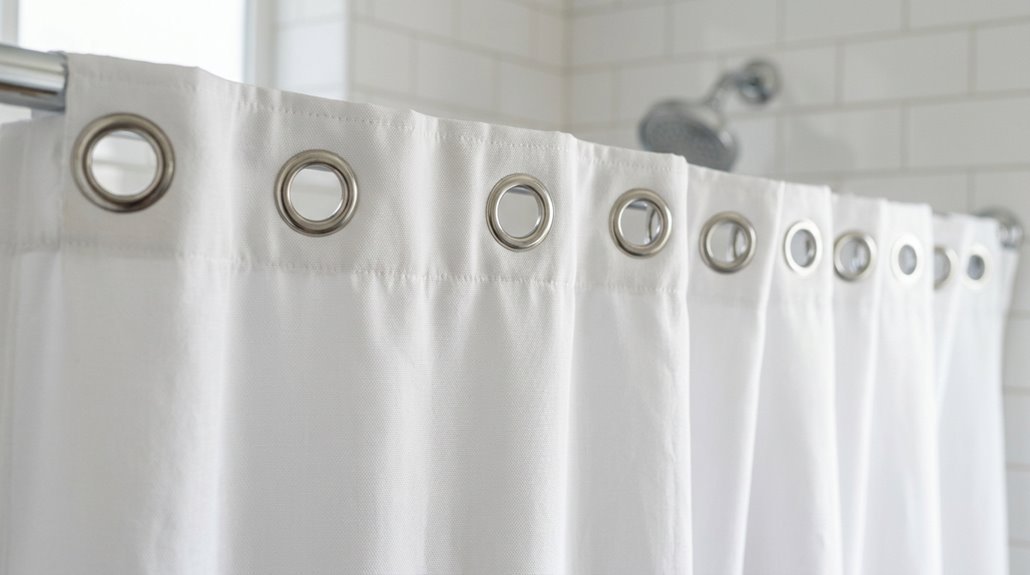
Most standard shower curtains have exactly 12 holes (grommets), which aligns with typical shower rods and hook sets. This 12-hole design works across standard 72-inch and 84-inch panels, eliminating measuring guesswork. However, your rod’s ring count matters just as much. If your setup has mismatched holes and rings, you’ll face uneven hanging and stubborn sliding. Addressing these compatibility issues requires matching your ring count to your grommet count for proper function.
The Standard: 12 Holes on Most Shower Curtains
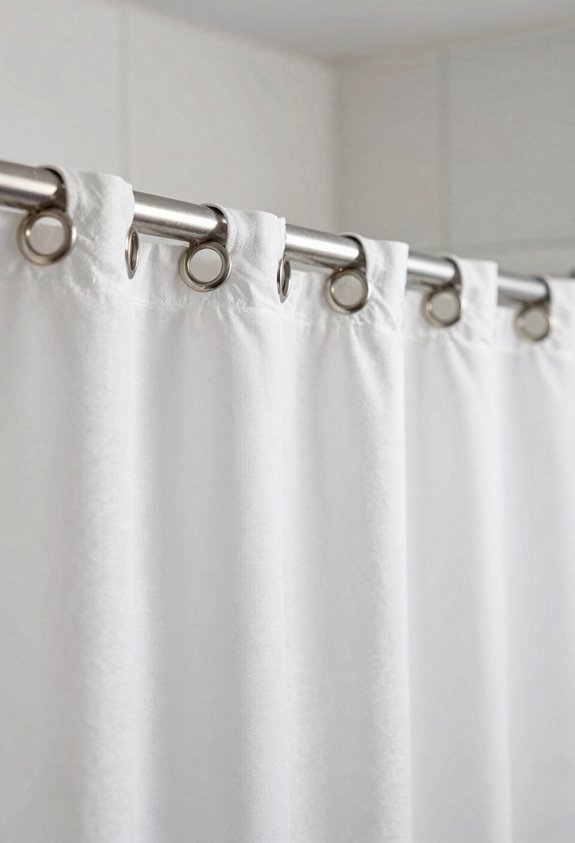
Ever wonder why your shower curtain seems to fit perfectly on some rods but awkwardly on others? It turns out there’s a simple answer: most standard curtains have exactly 12 holes.
These 12 grommets aren’t random. They’re deliberately designed to align with typical shower rods and hook sets found in standard installations. Whether you’re hanging a 72-inch or 84-inch panel, that dozen-hole standard curtain works across most bathrooms.
This universal sizing eliminates the need for measuring and second-guessing. Before manufacturers settled on 12 holes, debates about using 10 or 14 alternatives created confusion. Now any standard curtain with 12 holes will fit properly in most bathroom installations.

SPLASH GUARD: Included 4 sets of side curtain magnets allow extra control to prevent water from escaping, while keeping this 60x72 clear stall shower curtain liner tight to the wall/tile

Thicker material: AmazerBath uses 12 gauge material that is thicker than other conventional shower curtain liners on the market. The bottom has 3 clear stones that add weight to the shower curtain, keeping it in place and away from your body.

SPLASH GUARD: Included 4 sets of side curtain magnets allow extra control to prevent water from escaping, while keeping this 60x72 white shower stall curtain liner tight to the wall/tile
Why 12 Holes Became the Industry Standard
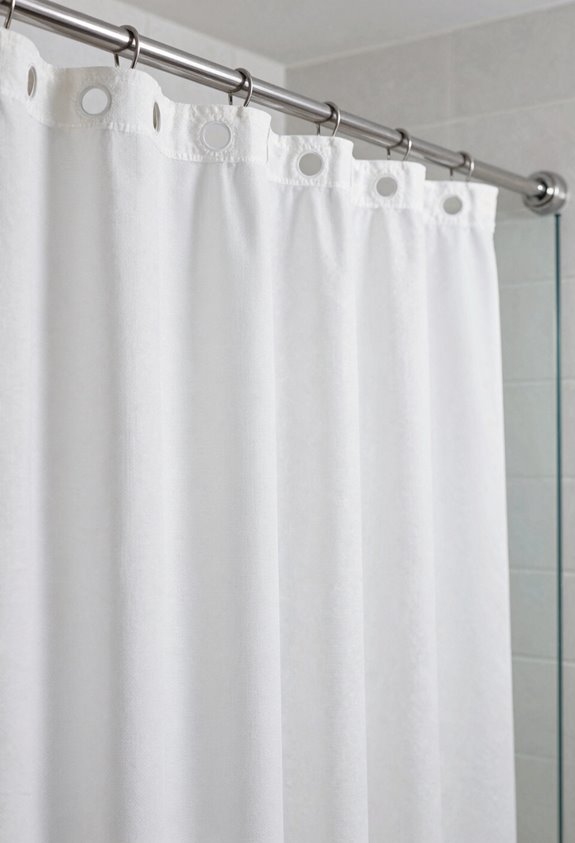
So why did manufacturers pick 12 holes instead of 10 or 14? The industry standard settled on twelve holes because it perfectly balances weight distribution. When you hang a shower curtain, those twelve holes spread the load evenly, preventing sagging and tautness that would compromise the setup.
| Reason | Benefit |
|---|---|
| Even weight distribution | Prevents sagging |
| Optimal spacing | Smooth gliding hooks |
| Historical consensus | Industry-wide compatibility |
The twelve holes industry standard emerged from practical testing. Manufacturers discovered that fewer holes meant uneven tension, while more holes created unnecessary complexity. The standard works because the curtain, liner, and hooks function together seamlessly. This standardization ensures compatibility across products without frustration.

Package Includes: you will receive 1 rotary curtain punch and 50 curtain grommets; The grommets feature a silent ring in the middle and are lightweight, making them easy to slide smoothly and effortlessly; They are quiet and easy to move on the curtain rod

Make a Shower Curtain from most any fabric!

These curtain grommets are designed for rods up to 1-1/2inch diameter
When You’ll Find 14 Holes on Extra-Wide or Extra-Long Curtains
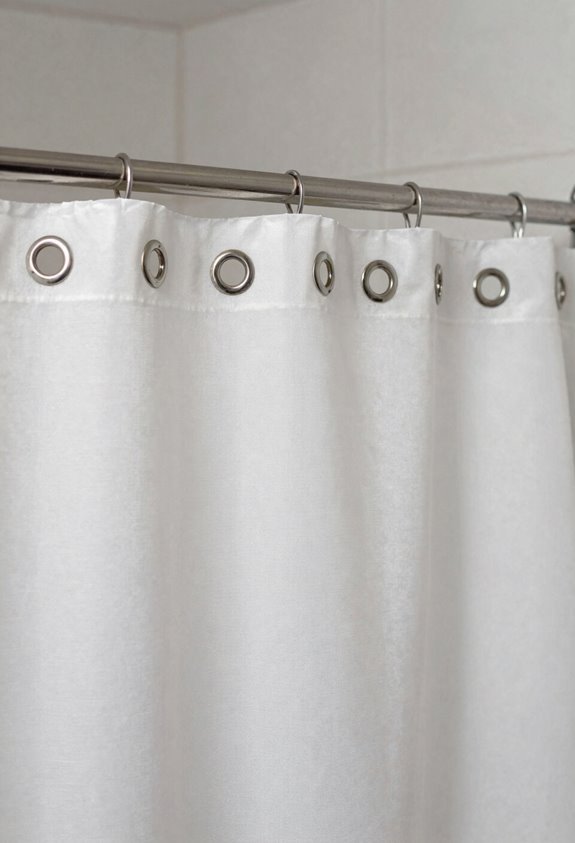
Why the upgrade matters:
- Accommodates additional rings for weight distribution
- Supports larger surface areas without bunching
- Enables consistent, effortless movement
- Prevents stress on individual attachment points
If you’re upgrading to an 84-panel or extra-wide curtain, expect those 14 holes. They’re not optional; they’re essential for keeping your larger curtain hanging perfectly.
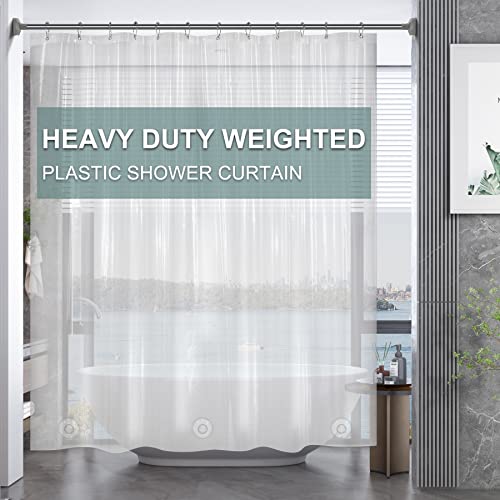
Waterproof and family-friendly material - AmazerBath clear shower curtain liner is made of premium PEVA material, there is no plastic smell. Super smooth surface design is created to resist water and promote water bead formation for swiftly rolling off the shower liner, keeping your floor dry and clean.

Waterproof shower curtain and liner 2-in-1: There is a water-proof coating on the surface of our fabric shower curtain liner, which promotes water bead formation. The treated polyester fabric is used to make water bead stay on the surface, quickly repel and dry. It can be used alone in the bathroom, no need to use together with a waterproof shower curtain liner.

SPLASH GUARD: Included 4 sets of side curtain magnets allow extra control to prevent water from escaping, while keeping this 60x72 frosted shower stall curtain liner tight to the wall/tile
Why Spacing Matters: How Hole Count Prevents Sagging
Have you ever yanked open your shower curtain only to find it bunching up in the middle like an accordion? Proper hole spacing prevents sagging more effectively than most people realize. When I counted my curtain’s holes, I discovered the real secret: proper distribution prevents sagging.
More holes spread weight evenly across the rod, so no single hook bears too much strain. Twelve evenly spaced holes work well for standard curtains. Too few holes means the middle sags dramatically. Too many holes provides unnecessary reinforcement.
| Hole Count | Weight Per Hook | Sagging Risk |
|---|---|---|
| 8 | High | Severe |
| 10 | Medium | Moderate |
| 12 | Low | Minimal |
| 14 | Very Low | Rare |
| 16 | Minimal | Almost None |
Spacing directly counteracts gravitational forces on fabric and hardware. Each additional hole reduces the load on neighboring hooks, preventing the accordion effect that occurs when weight concentrates in the center of the curtain rod.
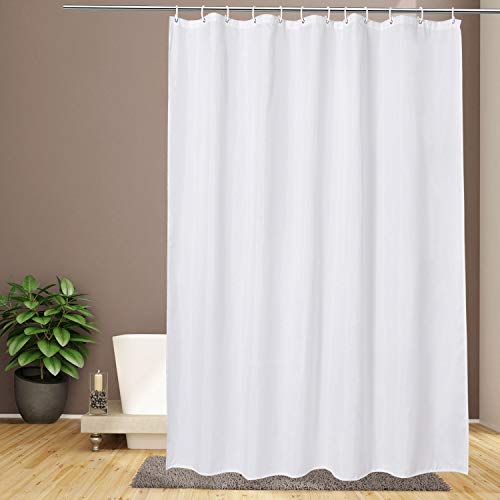
Size: 84inches wide by 72inches long / 7ft x 6ft /14 holes.This versatile shower liner can be used as a standalone shower curtain or as a shower liner for a cloth shower curtain.

Wide Shower Curtain Liner: 84 wide by 72 inch long, 14 button holes, hooks and rod are not included.

Keep Your Bathroom Dry - Our premium PEVA shower curtain liner is waterproof, protecting your decorative shower curtain and keeping your bathroom floor dry, shampoo and soap residues never leaking out.
Do Your Rings Match the Grommet Count?
Now that we’ve covered how proper spacing keeps your curtain from sagging, there’s another critical element: ensuring you have enough rings to hang it properly.
Proper spacing prevents sagging, but ensuring enough rings to match your grommets is equally critical for a professional finish.
I learned this through experience. My standard 72-inch curtain had twelve grommets, but I only grabbed ten rings from my linen closet. The result was bunching and gaps.
The Golden Rule:
Your ring count must match your grommet count. A 72-inch panel needs twelve rings. An 84-inch panel requires fourteen. I now use roller rings that slide smoothly, preventing friction.
Skipping this step creates a noticeable difference in appearance. Proper ring placement produces a professional finish rather than an obviously hastily assembled installation.

Smooth gliding - Engineered spherical roller balls of shower curtain hooks can glide smoothly and fast across shower rod.
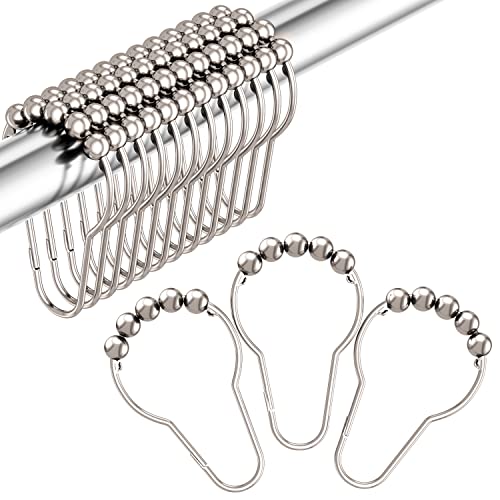
Rustproof & More Sturdy Stainless Steel - Stainless steel is more rust-resistant and sturdy than ordinary metal shower curtain hooks, allowing for years of use in the bathroom.

Ball design - The ball on the top of the shower curtain ring adopts a spherical design, reducing friction, sliding without noise, and pulling the shower curtain effortlessly.
How to Measure Hole Spacing on Your Curtain
I’ve learned that getting your hole spacing right makes all the difference between a curtain that glides smoothly and one that bunches up like an accordion. You’ll need to measure the distance between each grommet, adjust for any uneven spacing I’ve discovered on cheaper curtains, and make sure your rings actually match up with where those holes sit. This guide walks you through the tools and techniques for accurate measurement.

Keep Your Bathroom Dry - Our premium PEVA shower curtain liner is waterproof, protecting your decorative shower curtain and keeping your bathroom floor dry, shampoo and soap residues never leaking out.

WATERPROOF SHOWER CURTAIN LINER - Help keep water inside your shower or bathtub with this waterproof PEVA shower curtain; Use it on its own as a decorative shower curtain or pair it with a fabric curtain as a liner to help protect bathroom floors from splashes

WATERPROOF PEVA MATERIAL FOR EVERYDAY PROTECTION : Made from durable PEVA with a medium-weight 5 gauge thickness to help prevent water leaks and protect bathroom floors during daily use.
Measuring Distance Between Holes
Your shower curtain hangs perfectly on one rod but looks all wonky on another. The answer lies in understanding hole spacing on your standard shower curtain.
Finding the Space Between Grommets
I measured my 72-inch curtain and found twelve holes evenly distributed across the top. The process involved:
- Measured total width from first hole to last hole
- Divided that distance by eleven (the spaces between twelve holes)
- Got roughly 5.5 inches between each grommet
Why This Matters
Consistent hole spacing ensures your curtain drapes evenly. Some wider panels have fourteen holes instead, creating tighter spacing. Knowing your curtain’s specific hole spacing allows you to choose compatible rods and hooks, which prevents the bunching problem that occurs with mismatched hardware.
Tools For Accurate Spacing
What’s the secret to getting those grommets perfectly spaced? The right tools make all the difference.
My Essential Toolkit:
- Flexible tape measure (useful for curved edges)
- Pencil for marking intervals
- Ruler for double-checking measurements
- Your shower curtain rod nearby
I always measure my curtain size guide first, whether it’s 72 or 84 inches, then divide by grommet count. Using a flexible tape measure, I mark equal intervals along the top edge, accounting for margins so grommets align with the shower curtain rod centers. Before committing to anything permanent, I do a dry run with rings attached. This prevents mistakes and ensures those holes land exactly where you need them.
Adjusting For Uneven Grommets
Sometimes I’ll hang a shower curtain, step back to admire my work, and realize the grommets aren’t evenly spaced. They’re either bunched up on one side or stretched too thin on the other.
I measure the actual hole-to-hole spacing along the header using a ruler or measuring tape. This reveals where gaps exist.
| Curtain Width | Grommet Count | Typical Spacing |
|---|---|---|
| 72 inches | 12 grommets | 6 inches apart |
| 84 inches | 14 grommets | 6 inches apart |
Once I know the real measurements, I can adjust hook placement accordingly. When mixing liners and panels, both must have matching hole counts, otherwise nothing aligns properly. Measuring for two minutes prevents installation problems later.
Check Hole Count Before You Buy
Why does hole count matter when you’re picking out a new shower curtain? Mismatched shower curtain holes and ring counts create frustration. Most standard panels have twelve holes, but some larger designs feature fourteen. Mixing them up wastes money.
Before purchasing, I always:
- Count my existing rings or hooks
- Check product descriptions carefully
- Verify the exact hole count listed
I once grabbed a fourteen-hole curtain for my twelve-ring rod. Now I take thirty seconds to compare measurements before checkout. This simple step saves returns and prevents shopping mistakes. Verifying hole count upfront makes hanging day smoother.

【High Quality Material】➤Shower curtain hooks are made of premium metal,finished with a durable plating for long lasting rustproof which can be used in a long time,metal rings won't crack or break.Each curtain ring enables to load up to 60 lbs,and is able to hold your shower curtain perfectly with no doubt.
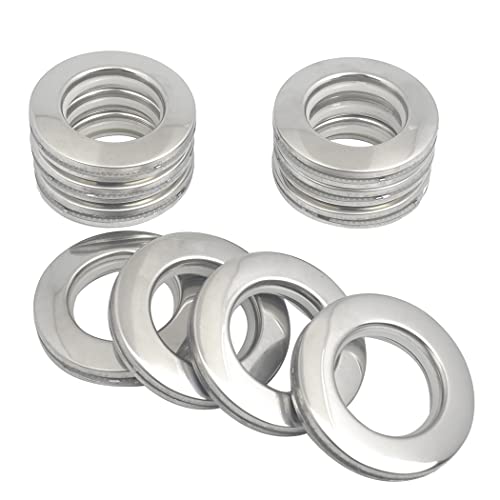
SIZE:10 pcs curtain grommets. Inside diameter: approx. 4.2cm/1.65", outside diameter: approx. 7.5cm/3" These eyelet curtain are designed for curtain rod with 1-3/8 inch diameter.
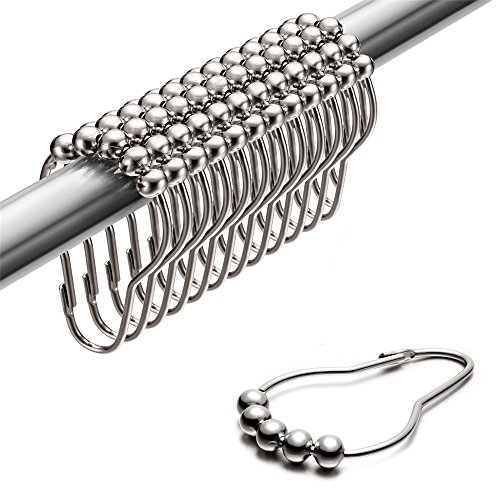
PLATED & POLISHED Chrome– The steel is polished with a polished nickel finish. The hooks sparkle in presence of light, adding a very elegant look to any bathroom.
Installing a Curtain When Holes Don’t Match Rings
Even after you’ve done your homework and counted everything twice, mismatches still happen. When your hole count doesn’t match your shower curtain rings, you’ve got solid options.
Quick Fixes:
- Add or remove rings at edges to balance the weight distribution
- Use clips or hook adapters to bridge the gap between holes and rings
- Switch to roller rings for smoother sliding when alignment’s off
Roller rings perform better when dealing with nonstandard setups. They glide easier and prevent the tangling that occurs with standard rings.
The Real Key: Matching your curtain’s hole count with your ring count keeps everything hanging evenly. This prevents sag and maintains proper function.
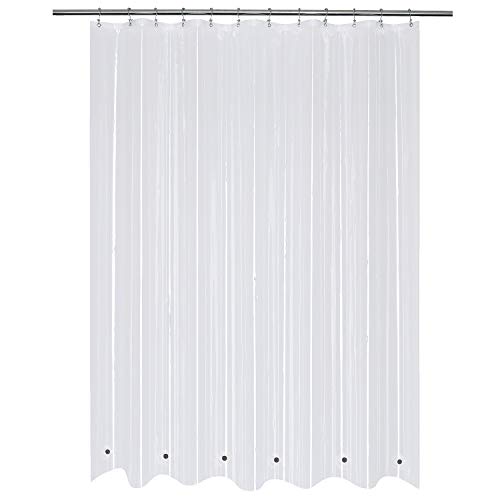
*Qualified: High quality PEVA shower curtain liner is a good choice for the person who requires heavy duty liner for bathtub. Made of clear plastic, the liner plays a function to better hold back water in a shower. Can be used as a liner or curtain simply

Premium PEVA: 3 magnets at bottom for iron-core bathtubs & 12 metal grommet holes, it can be used as a stand-alone shower curtain or shower liner
What Happens When Holes and Rings Don’t Align
Mismatched holes and rings create real problems. Your curtain hangs unevenly, bunches up in weird spots, and refuses to cooperate when you’re trying to slide it. When the spacing doesn’t line up, the weight distributes unevenly across your rod, putting extra stress on certain hooks or rings and wearing them out faster than they should. The curtain either gaps open in places or drags too tight in others, which defeats the purpose of having a shower curtain.

Thicker material: AmazerBath uses 12 gauge material that is thicker than other conventional shower curtain liners on the market. The bottom has 3 clear stones that add weight to the shower curtain, keeping it in place and away from your body.
Size: Width: 72 inches, Height/Length: 84 inches - Amazer shower curtain liner features 120 grams per square meter (Gsm) and is made of premium polyester fabric. 117g heavier than the same size 90 Gsm shower curtains of other brands.

Qualified: High quality PEVA shower curtain liner is a good choice for the person who requires light weight liner for bathtub.Convenient fold, simple and low cost, the liner plays a function to better hold back water in a shower.
Misalignment Issues And Solutions
How frustrating is it when you hang a shower curtain, only to discover that the rings don’t line up smoothly with the holes?
I’ve been there. When I used a 14-hole curtain on my standard 12-hook rod, I encountered serious misalignment issues. The gaps looked unprofessional, and the curtain wouldn’t slide evenly.
My Solutions:
Roller rings work wonders for compensating minor spacing problems. They let the curtain glide smoothly despite imperfect alignment. I also rearranged my rings strategically, spacing them more carefully across the rod.
What I Learned:
Don’t assume universal compatibility. Standard shower curtain setups often fail with nonstandard panels. Before purchasing, verify that your rod’s hook count matches your curtain’s hole count.
This prevents frustration and ensures even curtain movement.
Ring Spacing Weight Distribution
Beyond just making sure your holes and rings match up, there’s another layer to this puzzle that really affects how your curtain performs: weight distribution.
When I first hung my shower curtain, I didn’t realize how much the spacing between shower curtain rings actually mattered. If you’ve got twelve holes but only eight rings, that extra weight gets concentrated on fewer hooks. Each ring bears more burden, causing uneven stress and faster wear.
Ring spacing works best when it matches your hole count. A standard twelve-ring system with twelve holes spreads weight evenly across the rod, so no single hook gets overworked. When they’re misaligned, you’re basically asking some rings to do double duty.
The result is sagging sections, difficulty sliding, and curtains that fail prematurely.
Fixing Mismatched Holes: Practical Solutions
What happens when you hang your shower curtain and realize the rings don’t line up with the holes? This is a common frustration with a straightforward solution.
- Count your holes – Standard shower curtains typically have twelve holes, but rod setups may have only ten rings
- Add extra rings – Roller rings from the hardware store fill the gaps smoothly
- Switch your liner – A shower curtain liner with matching hole counts solves the problem
- Replace the panel – Select a new shower curtain with compatible hole counts, such as fourteen holes
Match your hardware to your curtain’s specifications. This ensures smooth operation and eliminates installation frustration.

[ANTI-CORROSION MATERIAL]: The shower curtain hooks are made of thickened wire diameter, rust resistant and durable, enough to hang shower curtains and liners, or a variety of bathroom and living items.

HEAVY DUTY METAL SHOWER CURTAIN HOOKS - The hook uses 3.8 mm metal wire, which is strong enough to support shower curtains and other heavy objects, and can withstand a maximum weight of 35lb.

The shower curtain hook set consists of 12 plastic hooks. It is convenient to install and remove on the shower rail.
Liner Ring Systems and Hole Count Compatibility
Most shower curtain liners come with twelve rings or button-holes as standard, which appears designed to match typical curtain rod setups. However, not every liner and curtain combination is compatible. When shopping for replacements, it’s important to verify whether your liner’s hole count matches your curtain’s rings, as the twelve-hole standard doesn’t always apply. Confirming ring system compatibility prevents mismatched setups that leave gaps in your shower.
Standard Ring Count Specifications
Most shower curtain liner systems come with twelve rings that match up with twelve button-holes on your curtain. This 12-ring/12-hole setup keeps everything aligned and balanced.
What you should know about standard rings and 12-hole compatibility:
- Universal fit – The twelve standard rings distribute weight evenly across your liner
- Spacing matters – Rings sit roughly 6 inches apart for smooth sliding motion
- Variations exist – 84-inch panels sometimes use 14 holes instead
- Roller rings help – Adding these ensures your curtain glides effortlessly across the rod
Many people grab the wrong liner assuming one size fits all. Always check your panel length before purchasing. The 12-hole compatibility remains industry standard, making replacements straightforward without compatibility issues.
Cross-Compatibility Among Systems
Every shower curtain liner and curtain I’ve encountered follows the same twelve-hole blueprint, which makes shopping for replacements straightforward.
Why Twelve Works for Everyone
This universal fit is intentional design. The twelve holes standard means you can swap your liner without worrying about compatibility issues. Whether you’re purchasing a new curtain or liner, that consistent hole count keeps things simple.
What This Means for You
When replacing bathroom fixtures, your existing rings work with almost any new curtain because the industry uses the same twelve-hole system. Many people don’t realize this and assume they need completely new setups when they don’t. Using this standard has reduced replacement costs and simplified renovations.