
A kitchen pantry cupboard is a tall, freestanding or built-in cabinet designed to store food, small appliances, and kitchen supplies behind closed doors.
The unit only earns its keep when its height matches your ceiling: a 172 cm model needs at least 8 feet of clearance or the room starts to feel like a storage closet, while a 155 cm version sits safer under standard ceilings but wastes vertical space in taller rooms.
The Rackhams 180cm freestanding pantry in grey spreads its load across wide feet rather than narrow legs that punch into old rental floors, which matters more than wall mounting ever did when you are hauling heavy cans upstairs.
Kitchen Pantry Cupboards with LED Lighting
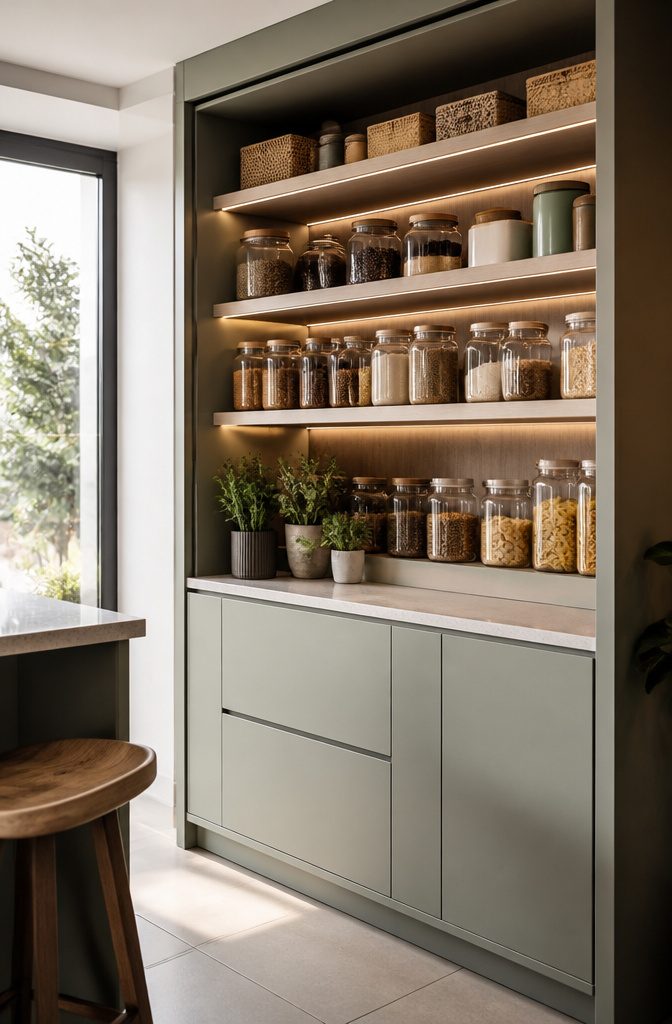
LED lighting in a kitchen pantry cupboard sounds like a luxury until you try finding a bag of rice at the back of a deep shelf at 6 a.m.
The 180cm model with integrated strips, shelves, drawers and a countertop puts the light where your body would otherwise block an overhead fixture.
The countertop LED is the most useful spot; it turns the unit into actual prep space rather than just storage you open and close.
The Merax Tall Kitchen Dresser Cabinet with LED and side pull-out shelves in white is a different approach.
The side pull-outs bring items to you, but the LED glow is mostly ambient, running along the upper frame like accent lighting in a retail display.
It helps you locate the cabinet at night, not so much the lentils inside it.
Built-in LED matters most when the pantry sits against a wall with no window nearby, or when it functions as a room divider and blocks ceiling light from reaching the work surface below.
If the cupboard tucks into a corner of an already-lit kitchen, the strips become something you switch on for atmosphere rather than necessity. That is not a waste, but it is not a reason to pay more either.

【Ample Storage Space】This spacious pantry storage cabinet offers organized storage with its upper cabinets for dinner plates and dishes, a 41.5" bar for small appliances or decorative items, and lower drawers and cabinets for snacks, tableware, and alcohol, ensuring a neat space and easy access to your essentials.The size of this pantry cabinet is 41.34 "* 15.75" * 67.72“.

⭐【Clutter-to-Calm in Seconds】With 2 spacious drawers to stash away odds and ends, wide tabletop and 2 open shelves for showcasing your decor, and roomy bottom cabinet for larger items, this storage cabinet meet to your various storage needs. You can absolutely end the chaos with this tall cabinet and enjoy a clutter-free home.

【Ample Storage Space】This spacious pantry storage cabinet offers organized storage with its upper cabinets for dinner plates and dishes, a 41.5" bar for small appliances or decorative items, and lower drawers and cabinets for snacks, tableware, and alcohol, ensuring a neat space and easy access to your essentials.
Tall Kitchen Storage Cabinets
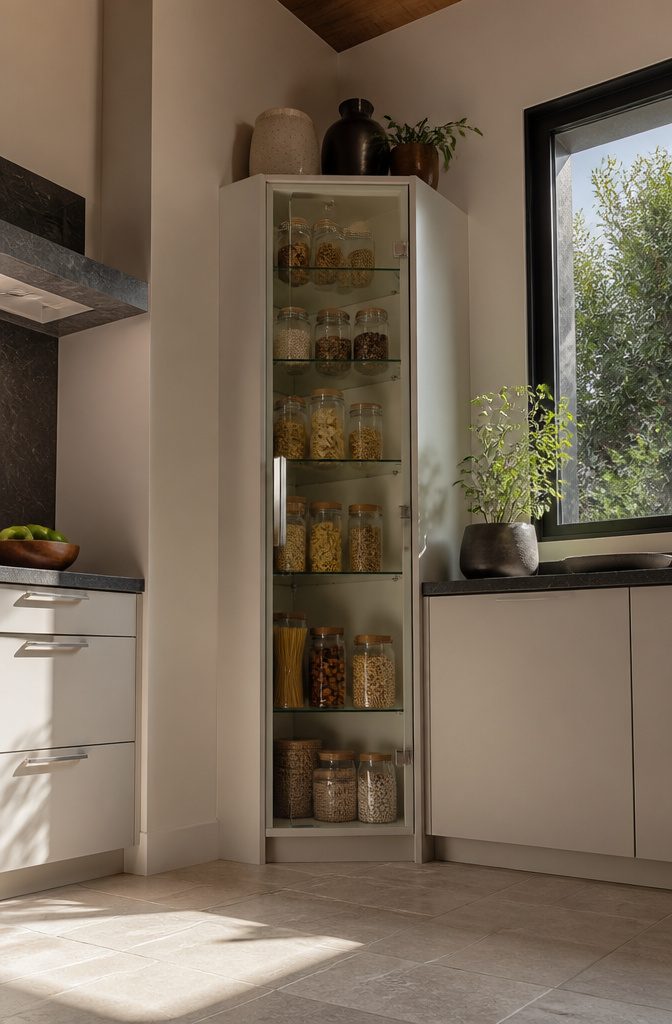
Vertical space in a kitchen is often the last thing people think to exploit.
Tall kitchen pantry cupboards make sense when floor area is tight but the ceiling height is there, because they store a lot without claiming more of the room you walk through.
The tallest practical option I have seen is a 172 cm H glass pantry.
That height puts the top shelf at a level most adults need a step stool to reach, which is fine for holiday dishes or bulk dry goods you do not touch daily.
A 167 cm COSTWAY model with built-in power outlets drops five centimeters but gains the ability to hide a microwave or charge a small appliance without stretching a cord across the counter.
Both of these need an 8-foot ceiling or taller to avoid looking crammed in; the unit itself is shorter than eight feet, but you want breathing room above it or the kitchen starts to feel like a storage closet.
For standard 8-foot ceilings, the 155 cm H standard pantry is the safer call. It clears the top comfortably, leaves space for a small plant or basket above, and still delivers four to five shelves of usable storage.
Measure your ceiling before you fall for the taller models. A 155 cm cabinet in a room with 9-foot ceilings looks undersized and wastes the vertical advantage; a 172 cm cabinet under an 8-foot ceiling with crown molding fights the architecture.

Power Up with Ease: Say goodbye to tangled cords! This pantry cabinet features a built-in charging station with 2 AC outlets, a USB port, and a Type-C port, plus a cable hole to hide those pesky wires for a sleek, clutter-free look.

Kitchen Pantry Cabinet – Stylish & Versatile Design:The AQY kitchen pantry cabinet features a sleek and modern look with a classic white finish, making it a perfect storage cabinet for kitchen, dining room, living space, or office. Designed to maximize vertical storage while blending seamlessly with your home decor.

【Versatile Tall Cabinet】The elegent tall cabinet with ample storage space can be placed in kitchen, living room, bathroom, or hallway. Without too much elaborate ornamentation, it will become the optimal choice of contemporary furniture.
Freestanding Kitchen Pantry Cabinets
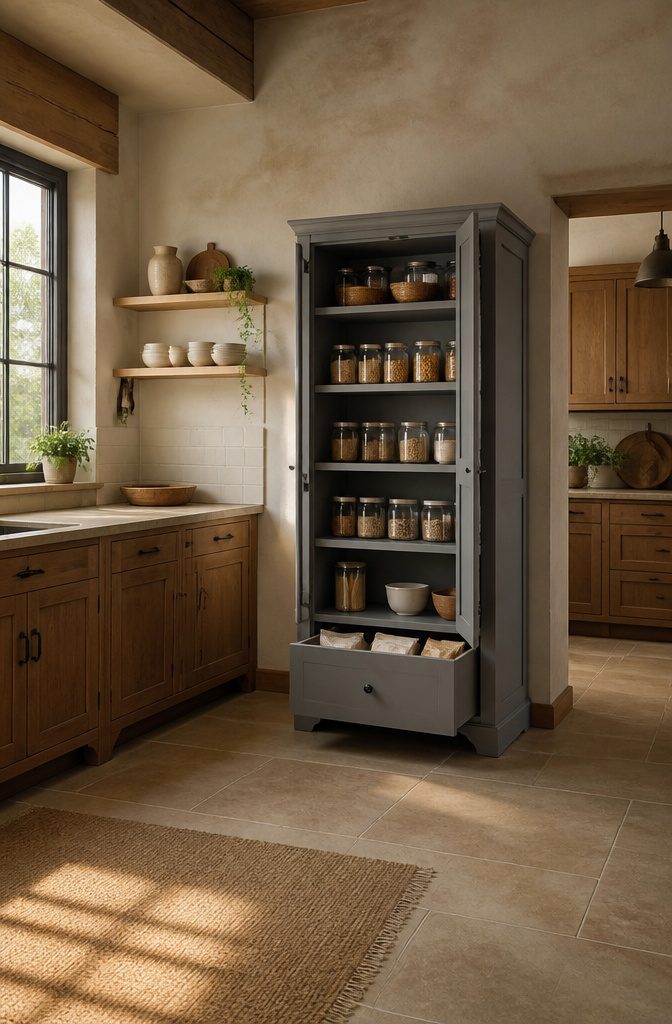
A freestanding kitchen pantry cupboard sits on its own feet and answers a problem built-ins never solve: what happens when you leave. No patching drywall, no leaving storage behind for the next tenant.
The Rackhams 180cm freestanding cabinet in grey runs five tiers of adjustable shelving above a bottom drawer, which puts daily items at hand while bulk goods stay visible higher up.
Floor weight limits matter more than wall mounting ever did. A full pantry loads more pounds per square inch than most furniture, and rental floors, especially in older buildings, have soft spots near joist edges.
I look for units with a solid back panel and cross-bracing, not just a frame that racks when the top shelf goes heavy with cans.
Wide feet or a plinth base spread that load better than narrow legs that punch into vinyl or old hardwood.
The grey finish on the Rackhams reads neutral enough to move between kitchens without clashing, which matters when your next rental has olive cabinets or warm oak tones you did not choose.
A freestanding unit does take up more floor space: it steals a few inches of walkway on all sides for stability and door swing.
In a galley kitchen, that can hurt. In a square room with an empty wall, it is the most flexible storage you will own.

【Streamlined Cooking & Stress-Free Storage】 Transform your kitchen routine by keeping essentials neatly organized and visible at a glance. Occupying only 4.3 sq. ft. of floor space, this pantry cabinet delivers a massive 21.3 cu. ft. (equivalent to 63 x 2.5-gallon buckets) of internal capacity, eliminating the daily hunt for ingredients and appliances

Farmhouse‑Inspired Visual Appeal: Rooted in classic farmhouse styling, this tall pantry cabinet delivers rustic visual character for kitchens, dining areas and living rooms. It blends decorative appearance with practical utility to fit into varied indoor layouts

MULTIFUNCTIONAL LED KITCHEN PANTRY: Transform your kitchen into a cozy coffee bar with a built-in LED light strip. Adjust color and brightness via phone app or the physical switch, and turn on music sync mode for lights that pulse to your music. Perfect for early-morning espresso, late-night snacks, or setting the mood when guests visit
Kitchen Cabinets with Adjustable Shelves
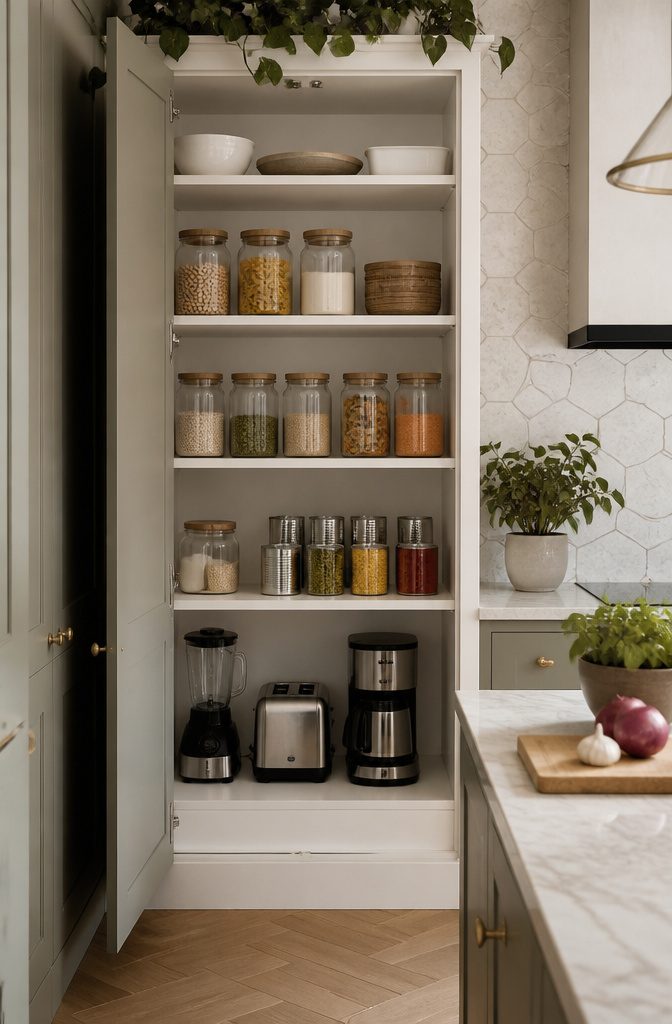
Shelf adjustability is the detail that separates a pantry you replace in five years from one that adapts as your habits shift.
Most fixed-shelf units force you to work around their spacing, which means wasted vertical space or awkward stacks that tip over.
A kitchen pantry cupboard with five adjustable tiers gives you the practical range to store tall cereal boxes one year and shorter mason jars the next without the cabinet becoming obsolete.
The Rackhams model spaces its shelves in roughly two-inch increments across a span that typically runs from about 8 to 20 inches between surfaces. At the tighter end, that fits canned goods and standard spice jars in neat, accessible rows.
Open it up toward the middle range and you have room for small appliances like a stand mixer or bread machine without shoving them onto a countertop.
At the widest setting, tall drink dispensers or bulk storage bins slide in without tilting.
I think the real value shows up when your household changes. A couple who buys flour in bulk needs different spacing than the same couple three years later with a toddler’s snack cups and sippy bottles to corral.
Adjustable shelves let the same cupboard serve both stages. The tradeoff is mechanical: pin or bracket systems can loosen if you overload a single shelf, so I distribute weight toward the bottom when I store anything heavy up high.

【L-SHAPED DESIGN FITS AROUND PIPES AND GARBAGE DISPOSALS】 The narrow top basket mounts left or right to clear your plumbing. The wide lower tier reclaims full vertical space under the sink, turning a blocked corner into organized, easy-to-use cabinet storage

[🔝 WARM TIPS]: Please note that this pull out cabinet organizer suitable for cabinets with internal width exceeding 13" and depth exceeding 21". This pull out drawer for cabinets with Upgraded Raising Pads are compatible with both frameless cabinets and framed cabinets with edge heights up to 0.4 inches. It is essential to carefully measure your cabinet's dimensions before installation to ensure compatibility.

WIDTH: The outer width of the wooden part of drawer is 31 inches, the depth is 21 inches, and the height is 3 inches. When adding the 1-inch width of the slide rails, the total width becomes 32 inches. the inner width of this drawer is 29.7 inches, the inner depth is 19.7 inches. There is only a 0.375 inch height between the bottom of the drawer and the ground. Bottom installation is workable only when the frame height is less than 0.375 inches. Subtract the width of the hinge when measuring
Kitchen Buffets with Storage Options
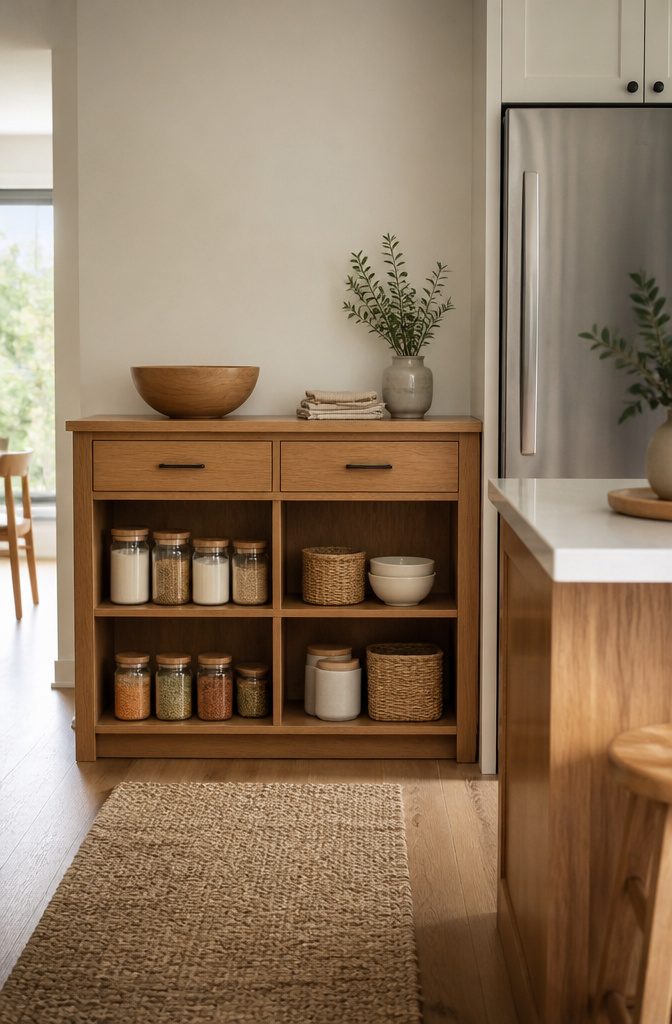
A kitchen buffet sits lower than a full pantry, usually in that waist-to-chest zone that keeps the top surface usable. That surface is the whole reason you choose one.
You gain a staging spot for unloading groceries, a place to rest a tray of chopped vegetables, or a display area for the bread bowl and salt cellar that used to clutter your counter.
You do give up vertical storage. A buffet stores less total volume than a tall cabinet, and the lower shelves can mean more bending to reach heavier items.
I think a buffet wins when your kitchen already has a primary pantry but it is bursting at the seams.
It also makes sense in a rental where a built-in wall of cabinets is not happening, or in a galley kitchen where a full-height unit at the end would block the walkway.
The best placement is against a blank wall near the refrigerator, so the flow from fridge to surface to stove stays tight.
Look for one 18 to 20 inches deep; anything deeper turns that handy surface into a catch-all for junk mail and lost keys.

Dimmable USB-Powered LED Under Cabinet Lighting with 10-Level Brightness Control

【SUPER BRIGHT】: 1050 lumen super bright strip lights, can easily illuminate the dark areas under the cabinet. 16.4ft tape light with 300 PCS SMD 2835 warm white LEDs, as auxiliary lighting or decorative lighting, is a perfect choice.

Warm White and Daylight White : Dimmable Under Cabinet Lights Plug-in LED Strip Lights for kitchen, 6 PCS pre-cut LED lights strip. White cabinet light Suitable for DIY your kitchen, cabinet, closet, counter, shelf, TV back, showcase and anywhere you want
Sideboard Kitchen Cabinets
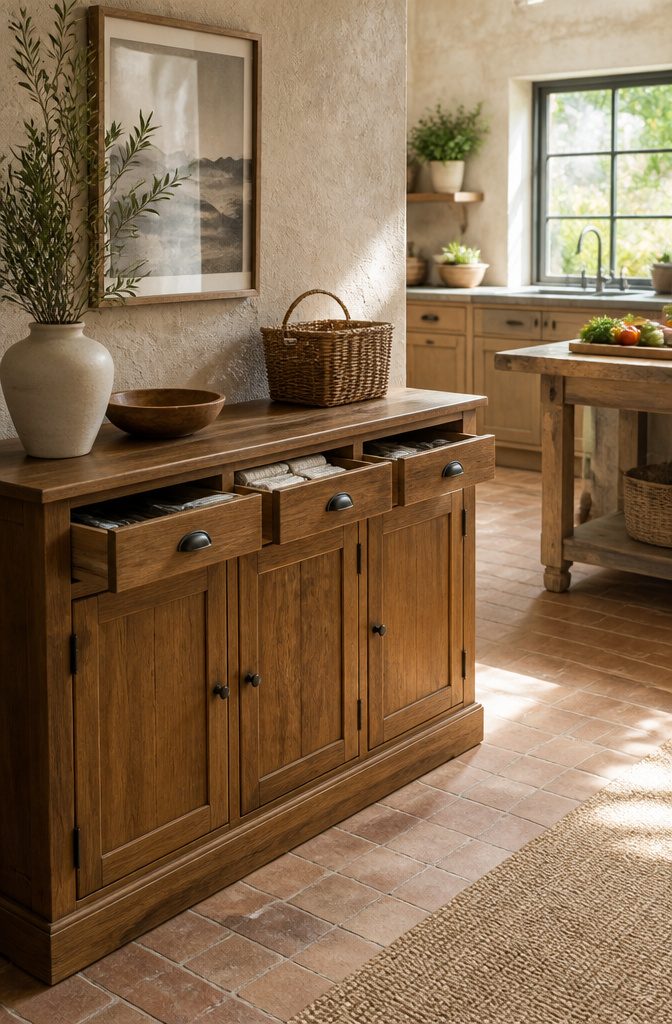
A sideboard kitchen cabinet with mixed doors and drawers gives you more flexibility than a single-format cupboard, but only if the ratio matches what you actually store.
A wooden sideboard with 3 drawers over 3 doors is the configuration I see most often in kitchens under 150 square feet, and for good reason: the drawers handle the small, daily-access items while the doors hide the larger, occasional-use stock.
The drawer-to-door ratio decides what you reach for easily. Three drawers is enough to separate utensils, linens, and packaged snacks at standing height, so you are not crouching for the thing you need twice a day.
The three doors below or beside them should hold the 5-pound bags, the bulk containers, the small appliances you pull out monthly.
Shift that balance toward more doors and you lose the quick-access layer; add more drawers and you sacrifice volume for items that do not stack neatly in narrow compartments.
In my view, the 3-and-3 split is the practical ceiling for a kitchen pantry cupboard that is not also a dedicated prep surface.
Go wider and the piece starts reading as furniture for a dining room, not working storage for a kitchen.

Streamlined Cooking & Stress-Free Storage: Transform your kitchen routine by keeping essentials neatly organized and visible at a glance. Occupying only 4.1 sq. ft. of floor space, this kitchen storage cabinets delivers a massive 24.3 cu. ft. (equivalent to 72 x 2.5-gallon buckets) of internal capacity, eliminating the daily hunt for ingredients and appliances.

Sturdy steel construction that lasts. Built from premium cold-rolled steel, this steel pantry cabinet delivers outstanding load-bearing strength and stability—it won't bend or sag even when holding heavy items. The scratch- and rust-resistant powder-coated finish withstands daily wear, moisture, and frequent use, giving you a dependable storage solution that lasts for years. Unlike easily damaged wood cabinets, our steel storage cabinet is easy to clean and keeps its brand-new appearance even in high-humidity environments like kitchens and garages.

『♕High-quality Material』The kitchen pantry storage cabinet is made of large-sized thickened cold-rolled steel plates, each shelf has good load-bearing capacity, and the reinforced structure makes the steel pantry more sturdy. The freestanding 4 tier pantry adopts textured electrostatic powder spraying technology, which is scratch resistant, odorless, and easy to clean, can store any item
Kitchen Cupboards with Drawers
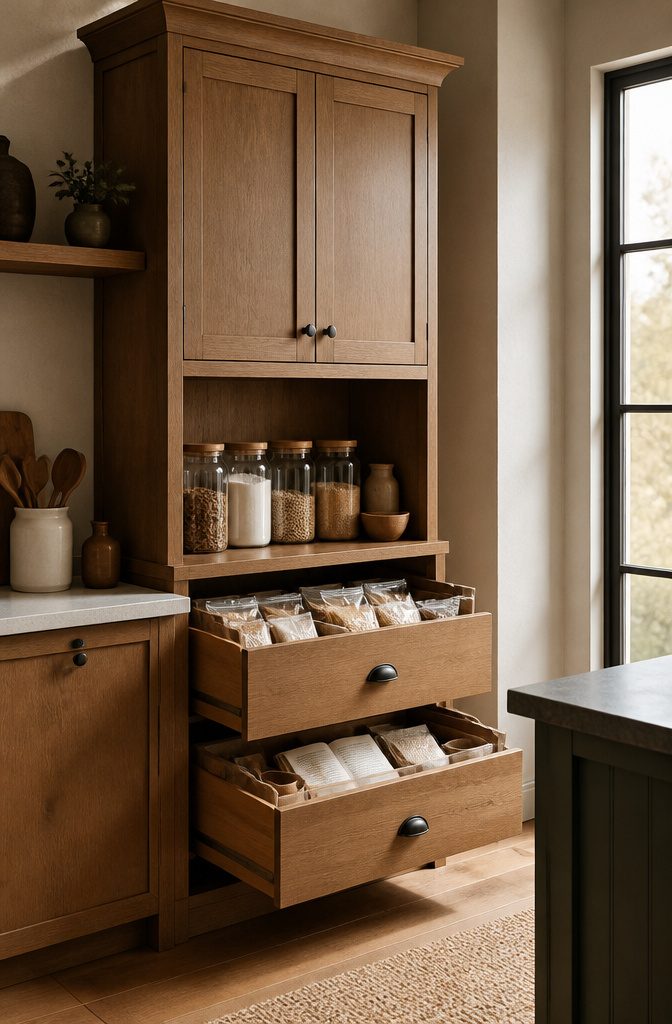
Drawers change how you use a kitchen pantry cupboard, especially in the lower half where reaching past the first row of cans means kneeling and digging.
A drawer on full-extension slides brings everything to you, which matters more than most people realize until they live with it for a month.
The cost is real: the box and hardware eat about 15 percent of the interior volume compared to the same footprint with a fixed shelf behind a door. You pay for that convenience in lost storage and in upfront cost.
For deep storage of heavy items, I still prefer drawers.
Bags of flour, pet food, and bulk rice sit at the back of shelves and stay there until they expire. A drawer forces rotation because nothing hides.
The exception is tall, occasional-use items like a stand mixer or a roasting pan. Those belong behind a door on an adjustable shelf, not wedged into a drawer that never fully opens because something else is in the way.
If you are choosing between a full bank of drawers and a mixed cabinet, the mixed setup wins for most households.
Two drawers below for daily dry goods, one door above for the tall stuff you use twice a year. That ratio holds up in almost every kitchen I have planned.

Robust Metal Construction: Built with 0.9mm reinforced steel and a sturdy 5-layer structure, this pantry storage cabinet resists rust, moisture, and impact. With no added formaldehyde, it creates a healthy, secure storage environment for your family

【Ample Storage Space】- The pantry features both the upper and lower cabinet with 2 adjustable shelves, which allow you to adjust the height in 3 levels to meet your individual needs. Pantry cabinets are perfect to store living goods, small appliances, cookware, and a variety of kitchen supplies. With its dimensions measuring 27.6"W x 13.4"D x 70.9"H.

Spacious, Stress-Free Storage: This 29.5" x 15.7" x 70.9" kitchen pantry cabinet makes smart use of vertical space with 7 compartments, helping you organize food, cookware and supplies neatly—so your kitchen feels calmer, tidier and more in control
Kitchen Pantry Cabinets with Power Outlets
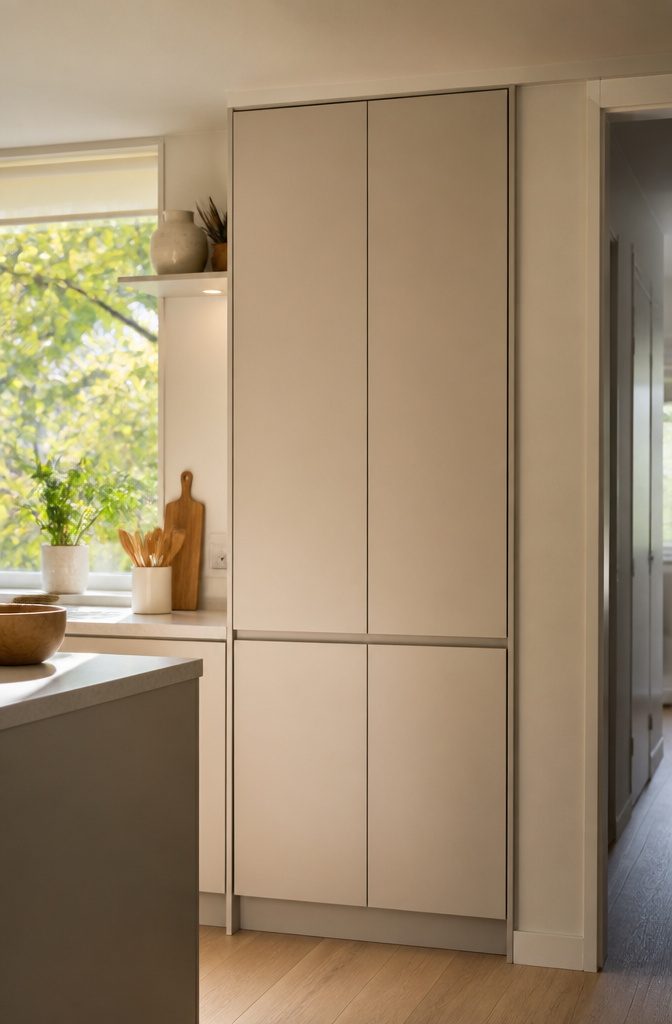
Built-in outlets change how you actually use a pantry cupboard. The COSTWAY model around 167cm includes a strip inside the cabinet body, which lets you park the coffee maker or microwave behind a closed door instead of hogging counter space.
What you gain is cleaner sightlines in a small kitchen, but the electrical requirement means the unit needs to sit against a wall with an existing outlet or a retrofitted one.
Cord runs through the back panel are standard, yet placement still matters; too far from a socket and you are adding conduit or calling an electrician.
The premium over a basic pantry of similar size runs roughly thirty to fifty percent. For a weekend project on a few hundred dollars, that only makes sense if you genuinely need the appliance storage.
Otherwise you are paying for convenience you will not use, and a plain shelf unit leaves more budget for the things that go inside it.

End Storage Woes: Featuring 6 generous cabinets with adjustable shelves for kitchen overflows, 3 deep drawers to organize small items and a spacious 55" wide countertop for frequently used appliances, this large kitchen pantry is definitely a storage Master!

[Perfect Storage Solution]: The storage cabinet includes 4 enclosed cabinets, a 38’’ large countertop, and a designated space for a microwave stand. kitchen pantry cabinet is ideal for storing tableware, appliances, cups, canned goods, and wine, combining functionality with generous storage capacity.

⭐【Large-Capacity Storage】TEENFON kitchen pantry cabinet offers 9 enclosed compartments, and 3 adjustable shelves to fit items of different sizes. Equipped with smooth drawer with divider—perfect for organizing plates and dishware. The open countertop keeps your microwave or coffee maker within easy reach.
Kitchen Cupboards in Various Colors
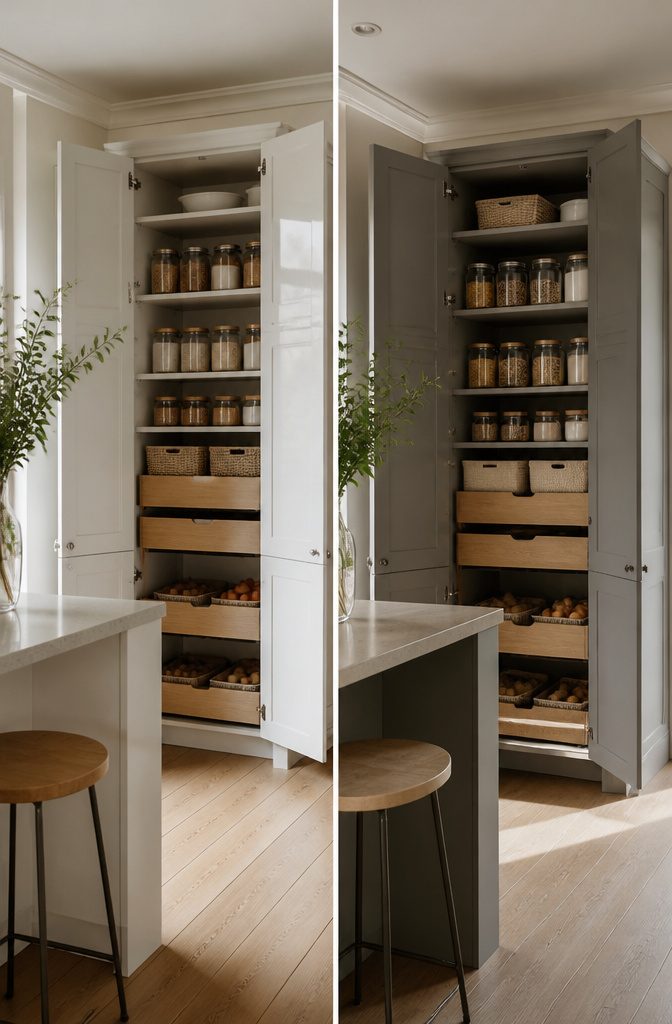
White is the default for a kitchen pantry cupboard for a reason: it bounces light and matches most kitchens without a second thought.
But white also shows every scuff, grease splatter, and fingerprint the moment they land, especially on the lower doors where hands actually touch.
A grey option like Rackhams’ sits one step away from that. It still reads neutral, yet the mid-tone hides daily wear better and doesn’t telegraph dust the way a pure white surface does.
The Merax white leans cooler, almost blue-white, which looks sharp in photos but ages faster in real kitchens.
Warmth matters here. A softer white or a muted grey forgives more than a stark shade.
Paint and laminate split the difference on repairs.
A painted cabinet, MDF or wood underneath, takes a touch-up with matching latex and blends back in. Laminate resists stains longer, but once the surface chips, you’re patching a sealed layer that won’t accept paint the same way.
I’d rather live with a surface I can fix with a brush from the garage than one that stays clean until the day it doesn’t.

𝐌𝐚𝐱𝐢𝐦𝐢𝐳𝐞 𝐔𝐧𝐝𝐞𝐫 𝐒𝐢𝐧𝐤 𝐒𝐩𝐚𝐜𝐞 - Designed with a custom-fit silicone mat and L-shaped structure, this under sink organizer fits perfectly around plumbing while protecting cabinets from water, spills, and leaks. Measuring approximately 11.8"W x 15.9"D x 13.8-16.9"H, it’s ideal for most kitchen and bathroom cabinets.

【Sliding Drawer Design】The bottom drawer features a pull-out design, providing a convenient way to access items in a limited space.

Drawer Size & Total Width: The pull out cabinet drawer body measures 14" W × 21" D × 3.2" H,Including 2 slide rails,The total installed width is 15".
Kitchen Pantry Cabinets with Microwave Shelves
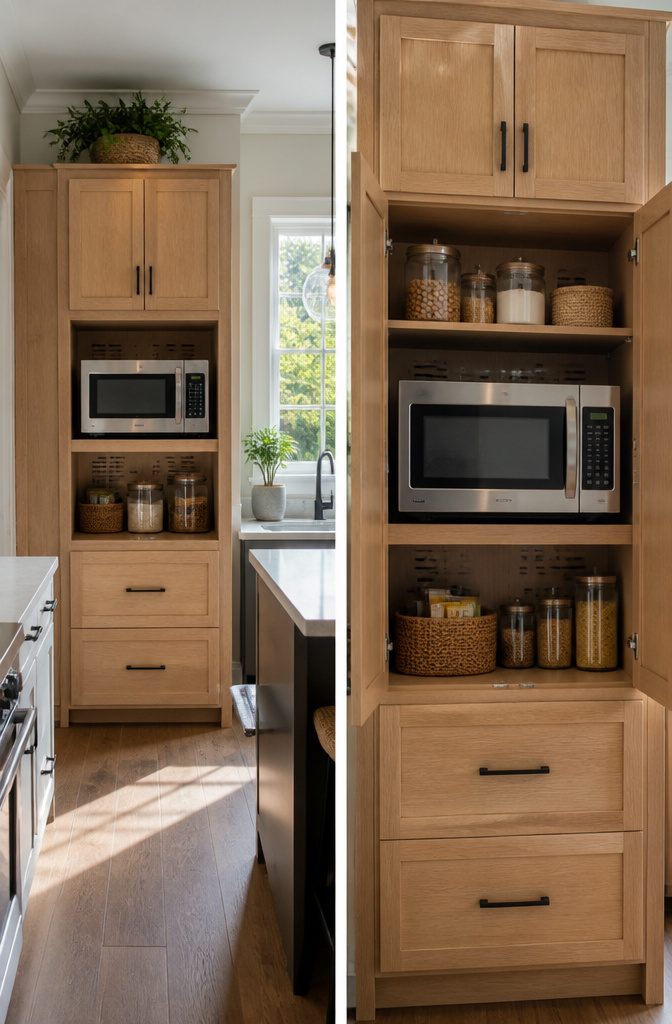
A microwave shelf inside a pantry cupboard only works if the cabinet is built for it.
Most standard pantry units lack the ventilation gap a microwave needs, and trapping hot air against wood or laminate finishes warps the shelving over time.
I look for models with a vented back panel or at least an open shelf design that lets heat escape upward.
Weight is the second problem.
A microwave on a pantry shelf puts load on a span that was probably designed for cereal boxes and cans. Particleboard shelves sag; I have seen them crack where the bracket meets the side panel.
Solid wood or a reinforced metal shelf bracket changes the math, but that adds cost and often means assembling a custom solution rather than buying off the rack.
Whether this integration saves space depends on what you are giving up. A microwave on a pantry shelf eats the exact height you would have used for tall items, stock pots, or a broom closet.
For some kitchens, the trade is worth it because it frees counter space. In others, you end up with a pantry that stores one appliance and nothing else efficiently.
I tend to suggest it for galley layouts where every linear foot of counter matters, and skip it when the kitchen already has a logical spot above the range or on a rolling cart.

【Samsion 11 in 1 Modular COB Light Strip】Our cabinet lighting kit includes a 11-output power adapter, supporting up to 11 light strips in parallel for full cabinet...
Types of Kitchen Cabinets
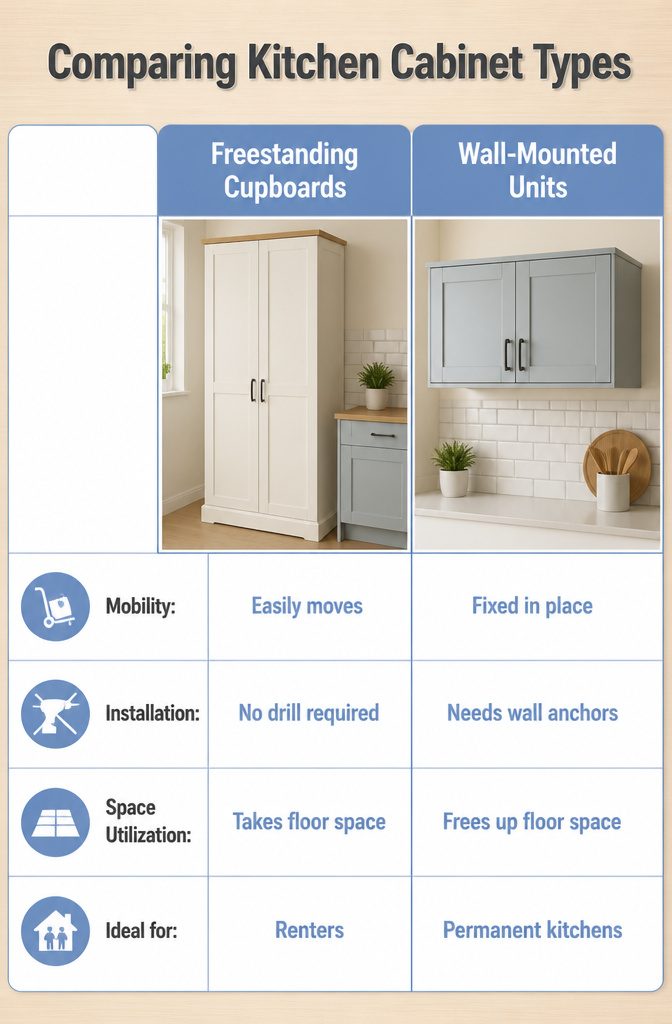
Freestanding pantry cupboards sit on the floor and move with you, which makes them the safest bet for renters who can’t drill into walls or commit to a layout.
Wall-mounted units free up floor space entirely, but they demand studs, anchors, and a level that reads true, so owners with permanent kitchens get more value from the trade.
Base units sit below counter height and work hardest when they’re part of a run, not standing alone, since their real capacity comes from continuous surfaces above and beside them.
The choice usually comes down to how long you’ll live with it. A freestanding kitchen pantry cupboard in a rental can follow you to the next apartment; a wall-mounted system stays with the drywall you drilled into.
I’ve seen people try to split the difference with "temporary" mounting that sags inside a year.
If you can’t commit to the wall, commit to the floor instead. Base units make sense when you’re already replacing cabinetry or building from scratch, less so when you’re solving one storage problem in a kitchen that otherwise works.
Storage Solutions and Space-Saving
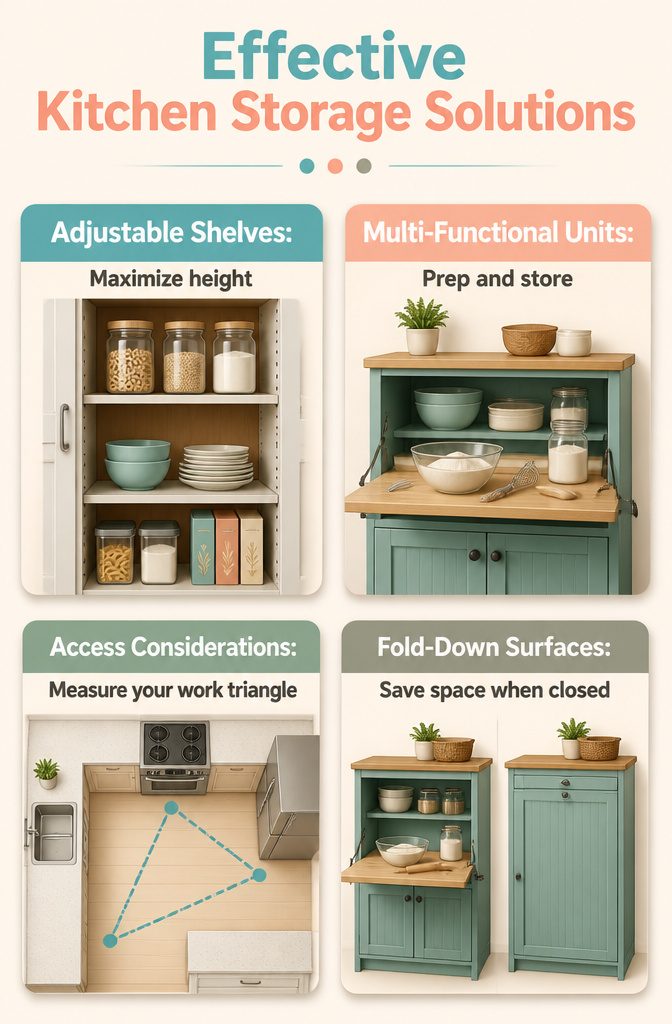
Adjustable shelves are the first upgrade I would make to any kitchen pantry cupboard that comes with fixed levels, because the spacing that looks right for cereal boxes leaves six inches of dead air above a stack of plates.
Most people set their shelves once and live with the waste.
A better move is to buy a unit with metal peg holes every inch or so, then experiment for a week before you commit. The hardware costs almost nothing extra, and the gain in usable height is immediate.
For a genuinely small kitchen, multi-functional furniture is where the real space shows up. A narrow cupboard with a fold-down front becomes a prep surface when you need one, then closes back over the flour and mixing bowls.
I have seen homeowners try to solve the same problem with a rolling cart, but the cart always ends up blocking a drawer or parked in the wrong room.
The cupboard that stays put and works twice as hard wins on a floor plan where every square foot has to pull double duty.
Access gets tricky: you cannot open the fold-down and stand at it when the oven door is ajar, so measure your work triangle before you buy.
Material Choices
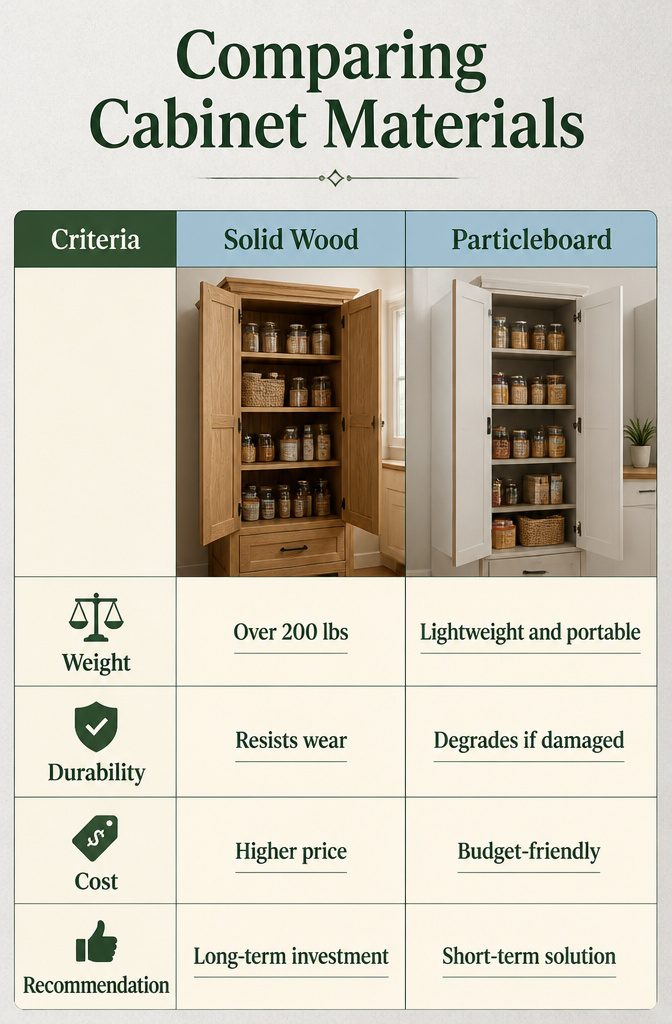
Solid wood pantry cupboards carry weight in more ways than one.
A full cabinet in oak or maple can top 200 pounds before you load a single can, which makes delivery day a two-person job and rules out most renters who might need to haul it up stairs or out again at lease end.
That said, the material takes abuse that would crack lesser boards, and a scuffed solid-wood shelf sands back to presentable where particleboard swells and stays damaged.
Particleboard with laminate facing is where most budget lines land, and for a weekend install it is often the right call.
The surface resists minor spills if you wipe them promptly, but the moment water seeps past a chip or corner, the core starts to degrade.
I steer first-home owners toward this material when the pantry sits against a stable wall and the household does not move often; the savings land around 40–60 percent against wood, and that difference buys better hardware or an extra shelf.
Glass doors on a pantry cupboard read as decorative more than practical. They force you to keep contents tidy, which some people manage naturally and others abandon within a month.
I have seen them work well on a single upper cabinet flanking a solid-wood base unit, where the visual break keeps a tall bank of storage from dominating a small kitchen.
For pure function behind a closed door, glass adds cost and fragility without adding storage.
What to Measure Before You Buy
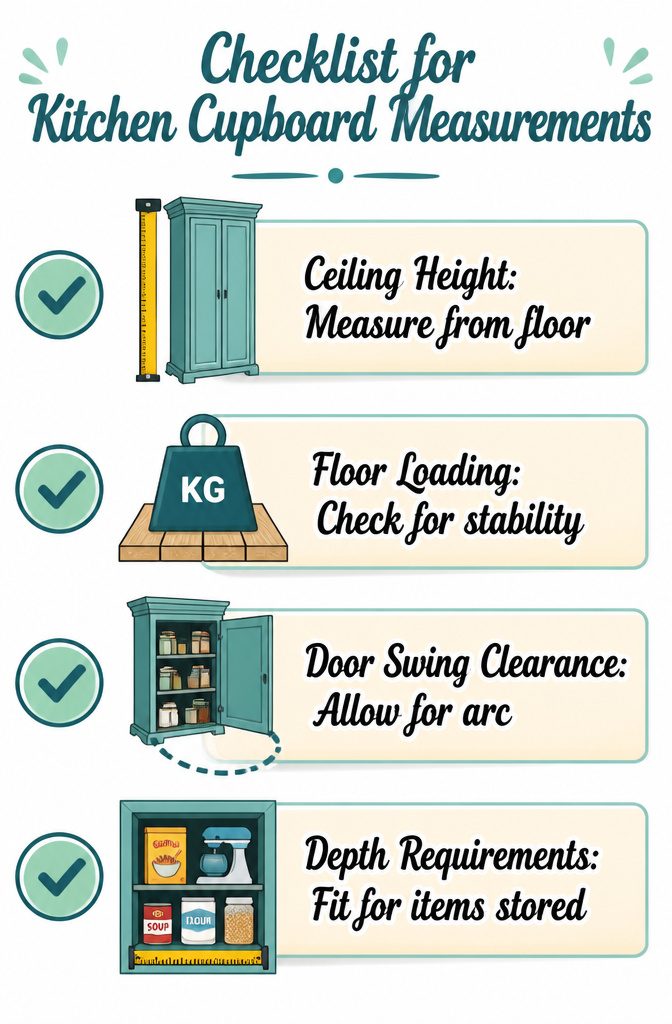
- Ceiling height is the first thing that eliminates options. A tall kitchen pantry cupboard looks right in a room with at least 8-foot ceilings; anything shorter and the piece either crowds the light or leaves an awkward gap above it that collects dust and visual clutter. Measure from floor to ceiling at the wall where it will sit, not the center of the room. Old houses can drift an inch or more from one corner to the other.
- Floor loading matters more than people think. A fully stocked pantry with canned goods runs heavy, and not every floor handles weight the same. Second-story kitchens over a garage, basements with slab issues, or any space with a slight bounce underfoot should get a lighter cabinet or be kept to shorter runs. Ask yourself whether the floor feels solid now; if it already sags, a massive unit will not fix it.
- Door swing clearance is where most buyers get surprised. A standard hinged door on a pantry cupboard needs roughly the same width as the door itself to open fully, and that arc has to stay clear of walls, appliances, and traffic paths. Sliding or barn-style hardware costs more but earns its place in tight kitchens. Measure the tightest spot the door would sweep through before you settle on a style.
- Depth should fit what you actually store, not what the showroom displays. A 12-inch shelf front-to-back handles cereal boxes and small appliances fine; soup cans and bulk flour need more. Pull everything you plan to store into one pile and measure the deepest item you cannot live without. That number is your minimum depth, and padding it by an inch or two saves the frustration of doors that will not quite close.
Frequently Asked Questions
What types of kitchen pantry cupboards are available?
Freestanding, wall-mounted, and base units are the main types. Freestanding cupboards move with you and work best for renters.
Wall-mounted units free up floor space but need solid stud mounting. Base units sit below counter height and perform best as part of a continuous cabinet run.
How do I maximize storage in my kitchen pantry cupboard?
Install adjustable shelves set on peg holes spaced roughly every inch, then test your layout for a week before locking them in.
Add multi-functional pieces like a cupboard with a fold-down front that doubles as a prep surface in tight kitchens.
Are there space-saving kitchen pantry cupboard options for small kitchens?
Narrow cupboards with fold-down fronts give you a prep surface when open and storage when closed.
Skip rolling carts that drift out of place; a fixed multi-use unit keeps your work triangle tight and every square foot working twice as hard.